The Complete Guide To Debt Settlement: What It Is, How It Works, And Whether It’s Right For You
Posted by Mike Leuthold on Sep 13, 2026
Table of Contents
- Why getting out of debt feels impossible (and why it is not)
- Step 1: face the numbers, your debt inventory
- Step 2: build a budget that frees up cash
- Step 3: choose a payoff method: snowball vs. avalanche
- Step 4: cut the cost of carrying debt
- How to think about payoff by debt amount
- When DIY is not enough: debt relief options
- Mistakes that keep people stuck in debt
- How to stay out of debt for good
- Frequently asked questions
Medical bills. A divorce. A layoff. You didn’t choose this debt, but you can start getting out of it today, one step at a time. This is a realistic plan, not a promise that you can eliminate debt in a fixed number of days. It covers building a budget, choosing a payoff method, cutting interest costs, and an honest look at when self-help isn’t enough.
Key Takeaways
- Paying only the minimum on a large balance can stretch repayment for years and cost more in interest than the original debt. This is a math problem, not a personal failing.
- Getting out of debt starts with one number: how much you can put toward principal each month beyond the minimums.
- The snowball method prioritizes motivation; the avalanche method targets total interest. The best method is the one you will actually finish.
- Cutting the interest rate helps, but it does not reduce what you owe. If the principal itself is unmanageable, a lower rate alone will not close the gap.
- Consumers with significant unsecured debt may find that DIY approaches extend repayment considerably. That can be a reason to evaluate debt relief options, weighing costs, risks, and eligibility.
- Staying out of debt after payoff takes the same discipline the payoff did: a budget, an emergency fund, and intentional use of credit.
Why Getting Out of Debt Feels Impossible (and Why It Is Not)
If you have been making payments for months or years and your balance barely moves, that experience reflects a real mathematical reality, not a personal failing.
Credit card minimum payments are typically calculated as a small percentage of the outstanding balance or a fixed dollar amount, whichever is higher. At a high interest rate, most of that minimum goes toward interest charges, leaving only a small portion to reduce the principal. The balance declines slowly while interest continues compounding on nearly the full amount. For a substantial balance, this structure can extend repayment far longer than most people realize.
The result is a cycle that feels like running in place: you pay, the balance barely moves, and the next statement shows nearly the same amount. That is not a failure of effort; it is the predictable outcome of a minimum-payment structure.
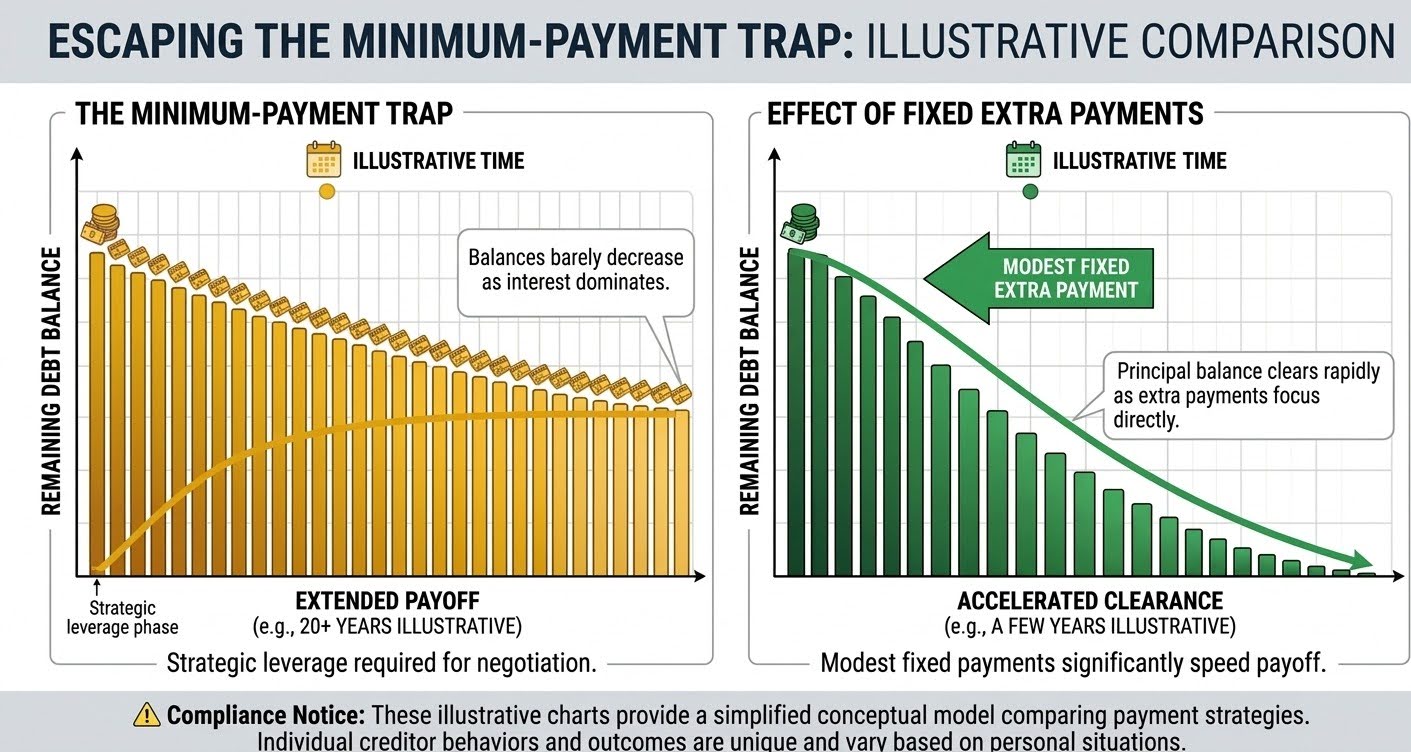
The reframe that matters: getting out of debt does not require a windfall or willpower alone. It requires a sequence of specific, manageable steps. Most people who successfully pay down significant debt followed a plan, consistently applied extra dollars, and made better decisions about the interest they were carrying. This guide is that sequence.
Step 1: Face the Numbers, Your Debt Inventory
Before you can make a plan, you need to know exactly what you are dealing with. This is the step most people skip, usually because the number feels too large to look at directly. Build a simple list for every debt you carry. For each account, record:
- Creditor name
- Current balance
- Interest rate (APR)
- Minimum monthly payment
- Due date
Total every balance. That number is your starting point. Separate secured from unsecured debt: secured debts such as your mortgage and auto loan are backed by collateral and follow different rules. The payoff strategies in this guide apply primarily to unsecured debt: credit cards, medical bills, personal loans, and collection accounts. Pay close attention to interest rates, since they drive which payoff method saves the most, whether cutting interest is worth pursuing, and whether the total cost of the debt makes DIY payoff realistic.
Step 2: Build a Budget That Frees Up Cash
A budget here isn’t meant to restrict every purchase. It is to find one number: how much you can put toward debt each month, beyond the minimums. That number fuels your payoff plan.
A Starting Framework: 50/30/20
The 50/30/20 framework allocates roughly half of take-home income to needs (housing, utilities, food, transportation), 30 percent to wants (dining, subscriptions, discretionary), and 20 percent to debt repayment and savings. Use it as a starting reference, not a rigid rule. Your actual numbers may look different, and that is fine. The goal is to find real surplus.
Finding ‘Hidden’ Cash
Before cutting anything meaningful, look for low-friction reductions: subscription services you use infrequently, fees on bank or credit card accounts you can waive or switch, insurance policies you haven’t compared recently, and unused memberships. None alone will eliminate a large debt, but a modest monthly surplus applied consistently to principal compounds faster than most people expect.
Stopping New Debt While You Pay Down Old Debt
A budget only works if the balance stops growing. If credit cards are the source of the debt, the most practical step is to stop using them regularly while you pay them down. Switch to a debit card for everyday purchases, remove saved card numbers from online retailers, and keep one card aside for genuine emergencies to add behavioral friction and prevent new charges.
When the Budget Does Not Close
Sometimes a complete budget review shows that the debt is larger than any realistic monthly surplus can address in a reasonable timeframe. That is not a failure; it is important information. It means interest-rate reduction alone will not solve the problem, and it is an honest signal to read the section on debt relief options below.
Step 3: Choose a Payoff Method: Snowball vs Avalanche
Once you know your surplus, the next decision is which debt to attack first. Two methods dominate personal finance, and each works well for different personalities.
The Debt Snowball (Motivation-First)
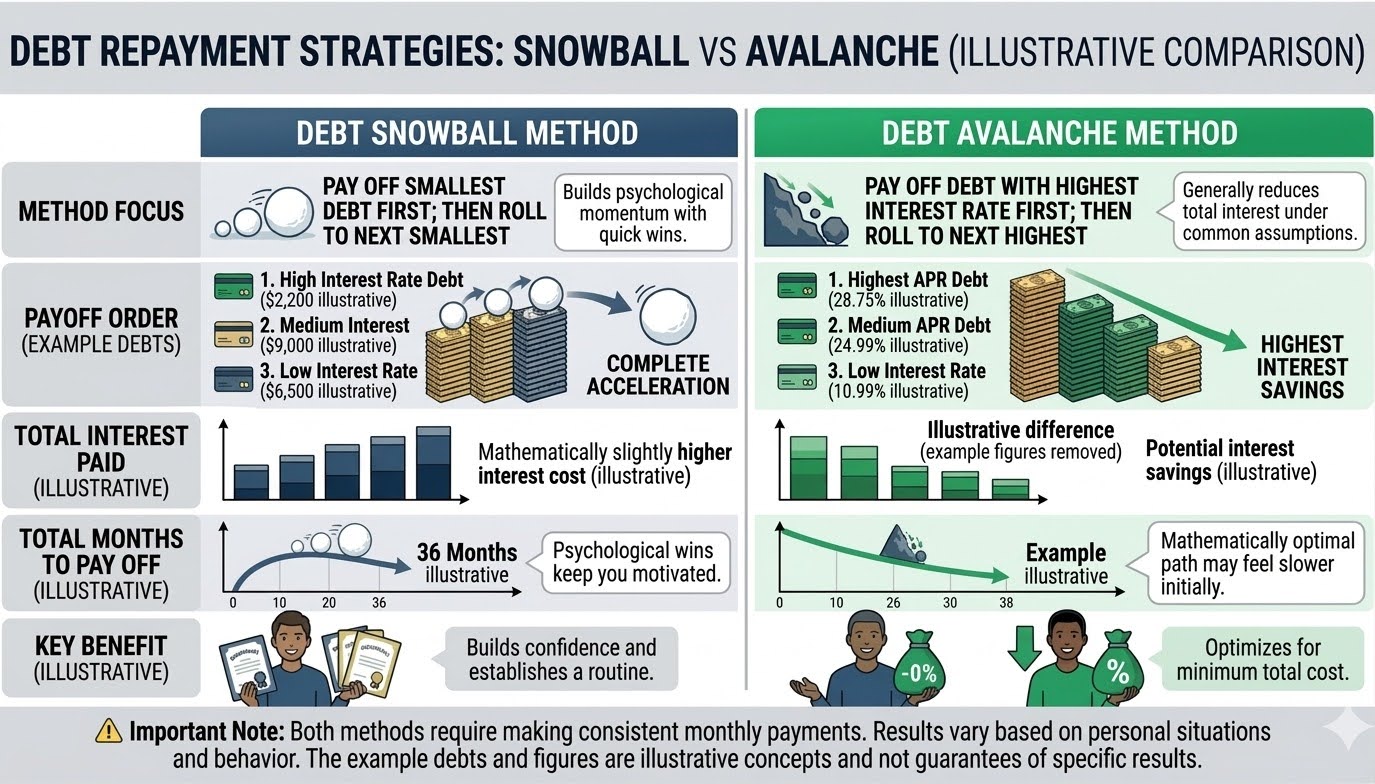
List your debts from smallest balance to largest. Pay the minimum on every account. Put every extra dollar toward the smallest balance. When it is paid off, roll that payment into the next-smallest. The snowball creates early wins: paid-off accounts disappear from your list, building momentum. Some research on debt repayment behavior suggests that early visible progress can help people stay with a plan, though results vary by individual.
Best fit: you need psychological wins to stay motivated; several small accounts create mental clutter.
The Debt Avalanche (Math-First)
List your debts from highest interest rate to lowest. Pay the minimum on every account. Put every extra dollar toward the highest-rate debt. When it is gone, roll that payment into the next-highest. Under common assumptions, prioritizing the highest-rate debt first generally reduces the total interest paid across all accounts, so more of every dollar goes toward reducing principal. For large balances at high rates, the difference in total interest paid between methods can be significant, though it depends on your specific balances and rates.
Best fit: you can stay disciplined without immediate wins; your highest-rate debt is also one of the larger balances.
The Honest Verdict
The avalanche generally saves more in interest under common assumptions. The snowball is often easier to maintain. The best method is the one you will actually finish. Many people use a hybrid: pay off one or two small balances for momentum, then switch to the avalanche. If you run the numbers and the payoff timeline stretches past what feels sustainable, that signals the problem may be bigger than a payoff method can solve, and the section on debt relief options below is where that conversation belongs.
How to Apply the Avalanche Method
- List all debts by APR, highest to lowest. Include current balance and minimum payment for each.
- Set your extra payment amount: your monthly surplus from your budget, beyond all minimums.
- Pay the minimum on every account. Never miss a minimum, since late payments add fees and can damage your credit.
- Apply every extra dollar to the highest-APR account, consistently, every month, until it is paid off.
- When an account reaches zero, roll its minimum payment to the next-highest-APR account. Your total monthly payment stays the same; the debt list shrinks.
- Repeat until all debts are paid. Each payoff accelerates the next.
For a detailed look at how your specific timeline plays out, the credit card payoff calculator guide walks through the numbers.
Step 4: Cut the Cost of Carrying Debt
As you pay down principal, a lower interest rate means more of every payment goes to the balance. Four main ways to do this, each with real trade-offs.
Ask for a Lower APR
Call the customer service line for any high-rate credit card and ask for a rate reduction. Have your on-time payment history ready. Some issuers will reduce rates for customers in good standing without a formal process. It costs nothing to ask, and it sometimes works.
Balance Transfer
A balance transfer moves existing high-rate credit card debt to a new card offering a promotional low- or zero-percent period, which can pause interest accrual so more of the payment reduces principal. Trade-offs: transfer fees typically apply from day one, usually a percentage of the transferred amount; the promotional period ends, often after 12 to 21 months, and the post-promotional rate is typically high. A balance transfer works well only if you clear or substantially reduce the balance before the promotional period expires.
Consolidation Loan
A personal consolidation loan replaces multiple high-rate debts with a single lower-rate loan and one monthly payment. The key fact: a consolidation loan does not reduce what you owe. You repay the full balance at a lower rate. Eligibility and pricing vary by lender and depend on factors such as credit profile, income, and debt-to-income ratio; many people carrying heavy unsecured debt have experienced credit-score drops that may make this path harder to qualify for.
Creditor Hardship Programs
If a temporary setback is the issue, some creditors offer temporary rate reductions, fee waivers, or reduced minimum payments for a defined period. These are usually free to apply for and do not require refinancing. They are designed for short-term disruption, not long-term over-indebtedness. The important limit on all four options: none reduce the principal you owe. They reduce the cost of carrying it. If the principal itself is unaffordable regardless of the rate, interest reduction is at best a partial solution.
For a full comparison of how these options fit into the broader picture, see Debt Relief Programs Explained.
How to Think About Payoff by Debt Amount
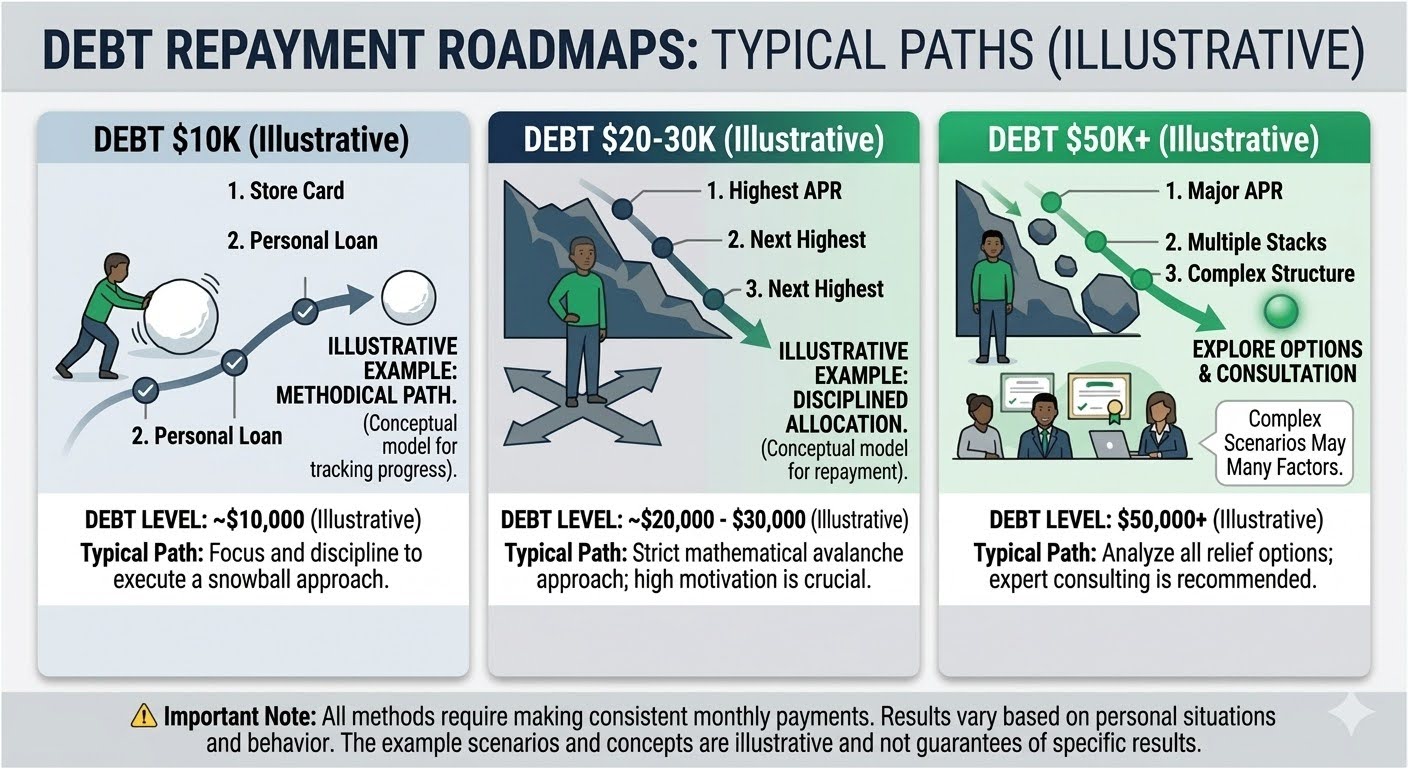
The realistic path can look different depending on how much unsecured debt you carry. The ranges below are general, illustrative observations, not a decision framework or advice about what you should do; the right approach depends on your income, rates, and circumstances.
Around $10,000 (illustrative)
At this level, DIY is often a reasonable starting point. A structured budget, a payoff method, and potentially a balance transfer or rate reduction may help you pay down a balance in this range over time. Timelines depend on your available surplus and interest rate, and consistency generally matters more than speed.
$20,000 to $30,000 (illustrative)
The math often remains workable, but the timeline tends to lengthen, and interest-rate drag becomes more consequential, which makes the rate-reduction steps above worthwhile. A careful budget, the avalanche method, and one interest-reduction step, if available, can form a realistic plan; the timeline may stretch to several years depending on the monthly surplus.
$50,000 and Above (illustrative)
With larger unsecured balances, DIY approaches often produce very long payoff timelines, and the math may not close on a realistic budget surplus alone. This is where an honest review of debt relief options becomes relevant. The primary question shifts: is the goal to reduce the rate while repaying the full balance, or to reduce the total balance owed? Those are different paths that lead to different options, discussed below.
When DIY Is Not Enough: Debt Relief Options
Many people who end up in a debt relief program tried the DIY path first. The steps above are real and work for many people. But at some point, the math stops closing, and recognizing that honestly is itself a productive step.
Signals That DIY May Not Be Enough
These circumstances may be reasons to evaluate a debt relief option, weighing costs, risks, and eligibility:
- A thorough budget cannot produce enough monthly surplus to clear the debt in a reasonable timeframe.
- You use credit to cover basic monthly expenses because your income doesn’t stretch to cover both essentials and debt payments.
- Minimum payments alone are becoming difficult to maintain.
- Collection calls have started, or a creditor has filed or threatened a lawsuit.
- The payoff timeline using the avalanche method extends beyond what you can realistically sustain.
Getting help is not a failure. It is a decision based on the numbers, and the right option depends on your circumstances.
The Main Options
- Debt management plan: a nonprofit credit counseling agency may negotiate reduced interest rates with your creditors. You repay the full balance over three to five years through the agency. This may fit when the problem is the interest rate and repaying in full over time is realistic.
- Debt settlement: Century’s program. You make monthly deposits into a dedicated account you own and control. Century’s team seeks to negotiate with your creditors to resolve eligible accounts for less than the balance claimed; creditors are not required to settle, and results vary. You approve every settlement before any money moves. The fee is charged per settled account only after a settlement is reached, you approve it, and at least one payment is made toward it; there are no upfront fees. Century’s debt settlement program may be available to consumers with significant unsecured debt and hardship who want to avoid a court proceeding, subject to eligibility, underwriting, creditor and account status, state availability, and other criteria. Using debt resolution services will adversely affect your creditworthiness.
- Bankruptcy: a federal legal process that either discharges qualifying debts (Chapter 7) or reorganizes them under court supervision (Chapter 13). It may be the right answer in some situations. Century does not provide legal or bankruptcy advice; consult a licensed bankruptcy attorney.
What Good Help Looks Like
Fees charged only after you approve settlements and at least one payment is made toward them. Representatives you can identify by name. Verifiable independent ratings. Honest disclosure of credit impact. No upfront fees. No guaranteed outcomes. A company that cannot meet these basics is not one to trust with your financial recovery.
Results vary. Not all consumers or debts qualify. Creditors are not required to settle. Using debt resolution services will adversely affect your creditworthiness and may result in collection activity, lawsuits, increased account balances from interest or fees, and tax consequences.
| If Your Debt Is Bigger Than a Budget Can Fix
A trained Century representative can explain Century’s debt settlement program, its risks, and eligibility factors, and review the information you provide. Request an initial consultation at no cost, with no obligation to enroll. Request a consultation Century’s settlement fee is charged per settled account only after a settlement is reached, you approve it, and at least one payment is made toward that settlement, in accordance with program terms and applicable law. Separate disclosed account-provider fees may apply. Fees vary by state. Results vary. Not all debts or consumers qualify, and not all clients complete the program. Using debt resolution services will adversely affect your creditworthiness. Century does not provide legal, tax, or credit repair advice. |
Mistakes That Keep People Stuck in Debt
Some habits that extend debt payoff are not dramatic. They are small, recurring decisions that compound the wrong way. Here are six common ones.
Paying Only the Minimum
The minimum is designed to keep you current, not to pay off the debt. Paying only the minimum on a high-rate balance can stretch repayment for many years. The fix: add any extra to the principal, even a modest amount, every month.
Closing Cards at the Wrong Time
Closing a credit card reduces your available credit, which can increase your credit utilization ratio and may lower your credit score. Closing your oldest card also shortens your average account age. If you are actively working to qualify for a consolidation loan or planning a major credit event in the next year, consider closing cards after, not before.
Using New Debt to Pay Old Debt Without Changing the Pattern
A consolidation loan or balance transfer only helps if the spending behavior that created the debt changes at the same time. Moving a balance to a new card and continuing to use both can double the problem. The restructuring tool is a bridge, not a solution on its own.
Draining a Retirement Account to Pay Unsecured Debt
Early withdrawals from a 401(k) or IRA typically trigger both income taxes and a penalty, which can make a significant portion of the withdrawal unavailable for actual debt payoff, and retirement funds also lose future compounding growth. Unsecured credit card debt, while expensive, is generally not worth the cost of an early retirement withdrawal. If you are considering this, consult a financial professional before acting.
Ignoring the Interest Rate When Choosing What to Pay First
Focusing on the largest balance feels intuitive, but if a smaller balance carries a significantly higher rate, the avalanche method will often save more in total interest. The rate is what makes debt expensive; the balance is just the starting line.
Waiting Too Long to Get Help
Every month of delay on a balance that is genuinely too large to resolve through DIY methods can mean more interest paid and, in some cases, more aggressive creditor action. The hardest part for most people is deciding whether the plan is working. If it isn’t, earlier intervention gives you more options.
Also, read:
- How to Negotiate Debt Settlement on Your Own
- How to Choose a Debt Settlement Company: What to Avoid
- General Credit-Management Considerations After Debt Settlement
- Life After Debt Settlement: Home, Credit, and Taxes
- 1099-C Explained: What It Means for Your Settled Debt and Taxes
How to Stay Out of Debt for Good
Build a Starter Emergency Fund First
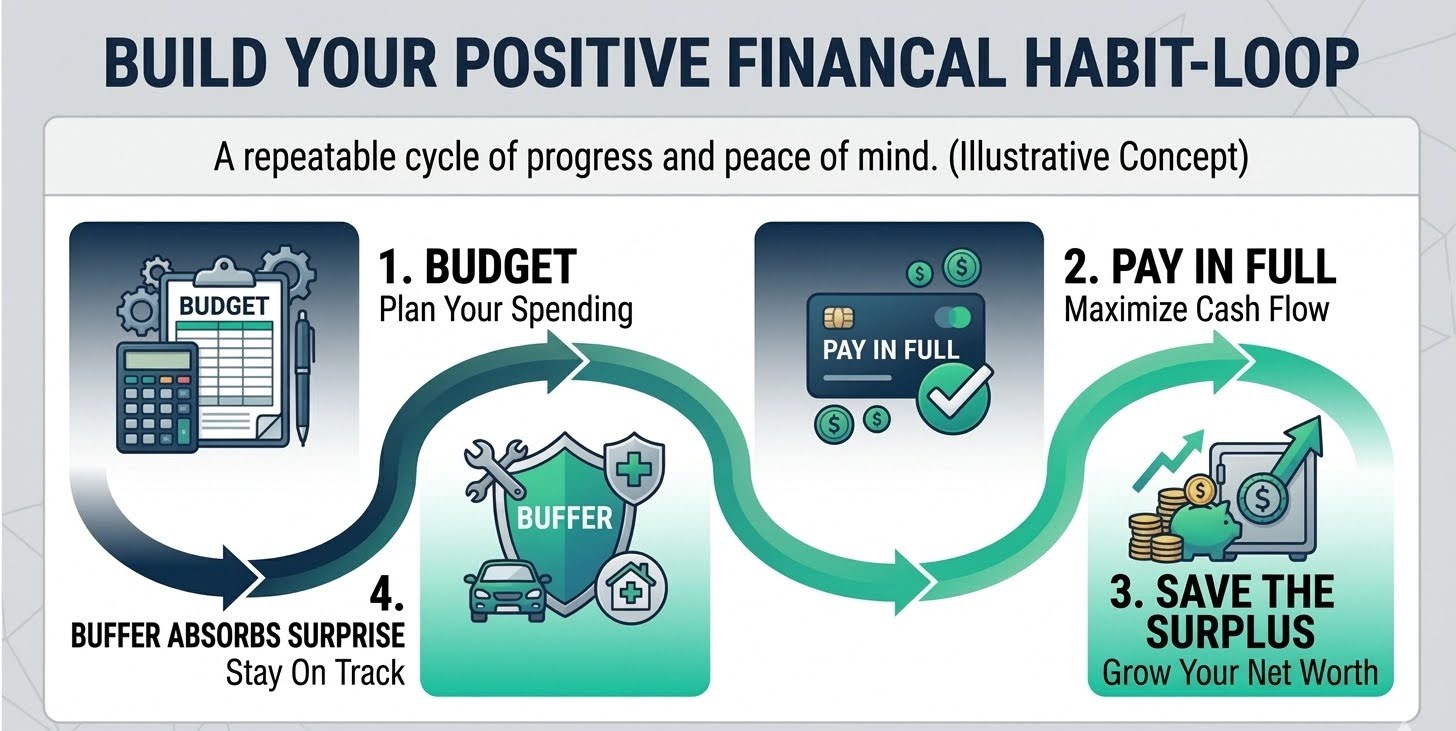
Before fully redirecting your monthly surplus toward debt, put aside a small emergency fund, around $1,000 to start. The most common reason people go back into debt after paying it off is an unexpected expense that goes straight onto a credit card. A modest buffer breaks that cycle. Once the debt is cleared, build the fund to cover one to three months of essential expenses.
Keep the Budget After Payoff
The monthly payment that went to debt doesn’t disappear when the balance hits zero. Redirect it to savings, retirement contributions, or a financial goal. People who treat the end of debt as permission to spend the freed-up cash often recreate the original problem within a few years.
Use Credit Intentionally
Keeping a credit card for its benefits and credit history is reasonable. Using it as a spending tool while paying the full balance each month means you never carry a high-rate balance, and automating the full payment removes the decision. Lower reported revolving balances relative to your limits may affect credit utilization, though credit-score effects vary by individual and scoring model. Century does not provide credit repair services or make representations about credit-score outcomes.
Frequently Asked Questions
How do I get out of debt with no money?
Start with the inventory: list every debt, balance, rate, and minimum payment. Then look for any surplus in your budget, however small. Even modest extra payments, applied consistently, reduce the balance faster than minimum payments alone. If your income genuinely does not cover essentials and minimums, that may be a reason to evaluate debt relief options, weighing costs, risks, and eligibility.
Is the snowball or avalanche method better?
Neither is universally better. Under common assumptions, the avalanche generally reduces total interest, while the snowball can be easier to sustain because of early wins. The best method is the one you will actually finish. Some people use a hybrid, starting with a small balance for momentum and then switching to the avalanche.
When should I consider a debt relief program instead of DIY?
There is no single trigger. When a realistic budget cannot produce enough surplus to clear the debt in a reasonable timeframe, when you are using credit for essentials, or when collection or legal activity has started, it may be reasonable to evaluate options such as a debt management plan, debt settlement, or bankruptcy consultation. Each has different costs, risks, and eligibility requirements.
Does debt settlement make sense for larger balances?
It depends on your circumstances. Some consumers with significant unsecured debt and hardship consider debt settlement after comparing alternatives and understanding the risks, including that using debt resolution services will adversely affect your creditworthiness and that creditors are not required to settle. A comparison of total cost, credit impact, taxes, and completion for your situation is more reliable than any general rule; a representative can explain Century’s program based on information you provide.
Will paying off debt improve my credit score?
Reducing balances and utilization may support credit health over time, but credit-score outcomes vary by individual, profile, and scoring model. Century does not provide credit repair services and makes no representation about credit-score outcomes.
Resources
- Federal Reserve G.19 Consumer Credit Report
- New York Fed Household Debt and Credit Report
- IRS Topic No. 431: Canceled Debt
- U.S. Courts: Bankruptcy Basics
Compliance Disclosure: This article is general educational information and is not legal, tax, or financial advice. Debt settlement program results vary based on individual circumstances. Not all consumers or debts are eligible for a debt settlement program. Century Support Services charges a settlement fee per settled account only after a settlement is reached, the client approves the settlement, and at least one payment is made toward that settlement, in accordance with program terms and applicable law. Fees are not charged up front and vary by state. Separate disclosed third-party account-provider fees may apply. Program term and settlement outcomes depend on the consumer’s specific financial situation, the creditors involved, and other individual factors. Century Support Services does not provide legal, tax, credit repair, or accounting services or advice, and makes no representation about credit-score outcomes resulting from enrollment in a debt settlement program. Settling debts for less than the full balance may have tax consequences; please contact a tax professional. Read and understand all program materials before enrolling. The use of debt resolution services will adversely affect your creditworthiness, may result in you being subject to collections or being sued by creditors or collectors, and may increase the outstanding balances of your enrolled accounts due to the accrual of fees and interest. However, negotiated settlements Century obtains on your behalf resolve the entire account, including all accrued fees and interest. References to third-party sources are for informational purposes only, and Century Support Services is not affiliated with, endorsed by, or sponsored by any government agency. A no-obligation initial consultation involves no fee and no obligation to enroll. Century Support Services is accredited by the Association for Consumer Debt Relief.

Mike Leuthold
Mike Leuthold is a seasoned executive with over 18 years of experience in the client financial distress industry, bringing a strong balance of operational leadership and consumer advocacy to his work.